
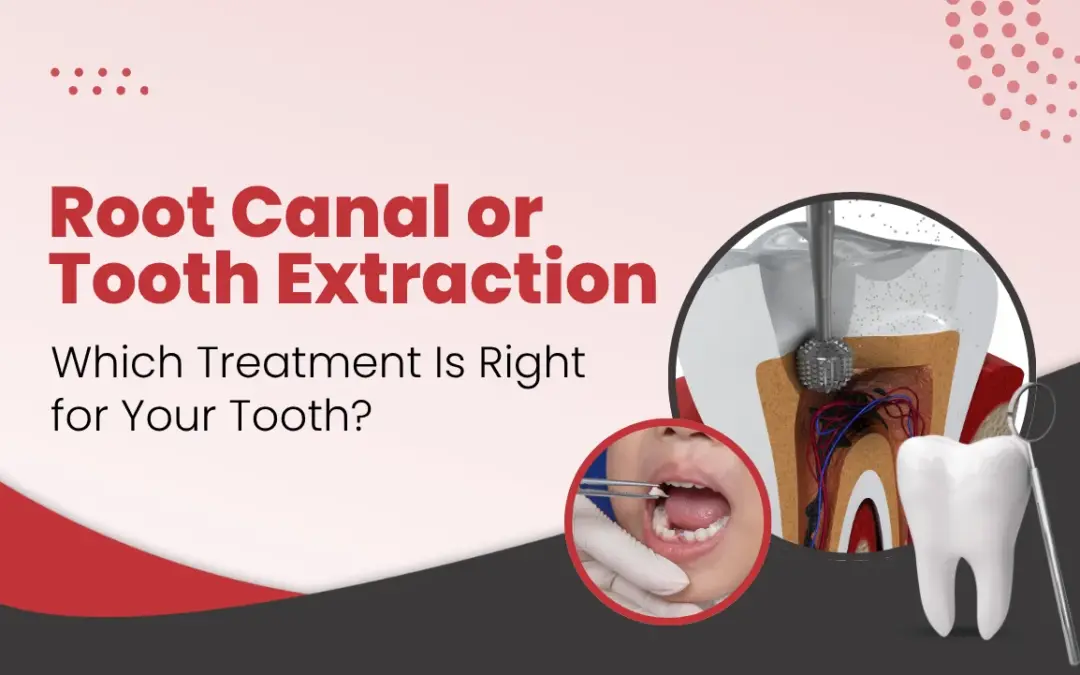
A damaged tooth doesn’t have to come out. Not always, anyway. In plenty of cases, root canal treatment clears the infection and lets you keep the tooth. Extraction only becomes the answer when there’s simply too little left to repair. What matters is how much healthy structure survives, how far the infection travelled, and whether the tooth can still do its job. So the real answer comes from an exam, not a guess.
According to Prof. (Dr.) Vineet Golchha, a leading dentist in Sector 116 Noida, “Most people hear ‘infected tooth’ and assume it’s coming out. It isn’t, not automatically. If the root structure still holds up, a root canal usually outlasts an extraction. Pulling the tooth should be the backup plan, not the opening move.”
When Does Root Canal Treatment Make Sense?
Not every damaged tooth needs to go. Root canal treatment works when there’s still enough healthy structure to build on.
Infection limited to the pulp: If decay hasn’t reached the bone around the root, the tooth’s usually worth saving. Cleaning and sealing does the job.
Enough tooth structure remains: A solid outer wall means a crown can hold. Without that wall, the odds drop fast.
No deep cracks reaching the root: A crack that stops at the crown can be sealed. One that runs into the root, though, can’t.
You want to dodge replacement costs later: A root canal plus a crown often costs less than extraction followed by an implant. Worth thinking through before you decide.
Curious if your tooth still qualifies? Learn more about our root canal treatment approach at WiseDent.
Root Canal vs Tooth Extraction: What's the Real Difference?
Both deal with a damaged tooth. But the outcome isn’t close to the same.
|
Feature |
Root Canal Treatment |
Tooth Extraction |
|
Goal |
Saves the natural tooth |
Removes the tooth entirely |
|
Procedure time |
30–60 minutes, often single sitting |
20–40 minutes |
|
Recovery |
Mild soreness for 1–2 days |
Swelling, healing over 1–2 weeks |
|
Long-term cost |
Crown needed, tooth is preserved |
Extraction plus replacement usually costs more later |
|
Bite & chewing |
Function stays close to natural |
Needs replacement to restore full chewing power |
Preservation vs removal: Root canal treatment clears out the infection and keeps your tooth exactly where it belongs. Extraction takes away the pain, sure, but it leaves a gap.
Recovery timeline: RCT settles in a couple of days, usually. Extraction sites take longer, and bone can start thinning if that gap sits empty too long.
What it costs over time: Extraction looks cheaper at first glance. Replace that tooth later with an implant or bridge, though, and the root canal probably would’ve cost less.
Impact on nearby teeth: A gap invites neighbouring teeth to drift. Save the original tooth, and that whole chain reaction never starts.
If extraction is unavoidable, take a look at the tooth replacement options before making a decision.
Still unsure whether a root canal or extraction is right for your tooth? A dental exam gives you a clear, case-specific answer.
Why Choose Dr. Vineet Golchha for Root Canal Treatment in Noida?
Dr. Vineet Golchha has spent over 18 years treating root canal cases at WiseDent. His fellowship in esthetic dentistry and implants means he looks at the bigger picture, not just the one tooth in front of him. Every case starts with digital X-rays and a microscope-assisted look before any drilling happens. That’s not optional, it’s how treat-or-extract stops being a guess. It’s this combination of experience and a thorough diagnostic approach that keeps patients across Sector 116 coming back.
A root canal only lasts if the cleaning, shaping, and sealing get done right the first time, no shortcuts. Dr. Golchha uses rotary systems and apex locators to keep that margin of error tight, which is part of why single-sitting RCT works well for straightforward cases.
Frequently Asked Questions
Can a badly infected tooth still be saved with a root canal?
Often, yes, if enough healthy structure and root support survive.
Is tooth extraction ever the better option?
Yes, with severe fractures, deep decay, or advanced bone loss.
Does root canal treatment hurt more than extraction?
No. Modern anesthesia keeps both procedures similarly comfortable throughout.
How long does a root canal treated tooth typically last?
With a crown and proper care, often a lifetime.
References:
Disclaimer: This blog is for general educational purposes only and is not a substitute for professional dental diagnosis; please consult a qualified dentist for personalised advice.