
A general dentist covers everyday oral health care, checkups, fillings, cleanings, and diagnosing most dental issues that come up. An orthodontist is a dentist who took it further, training specifically in tooth alignment and bite correction rather than general care. That’s really the difference between dentist and orthodontist, training and scope, not one being “better” than the other. So which one you need depends entirely on what’s actually wrong.
According to Prof. (Dr.) Vineet Golchha, a dentist in Sector 116 Noida, “People ask me all the time if an orthodontist’s better than a dentist. It’s not really a competition. A general dentist handles most oral health needs directly. For crowding, bite issues, or jaw alignment, that’s where an orthodontist’s extra training actually comes into play.”
What Extra Training Does an Orthodontist Have That a Dentist Doesn't?
Both start out with the same dental degree. It’s what comes after that splits the two.
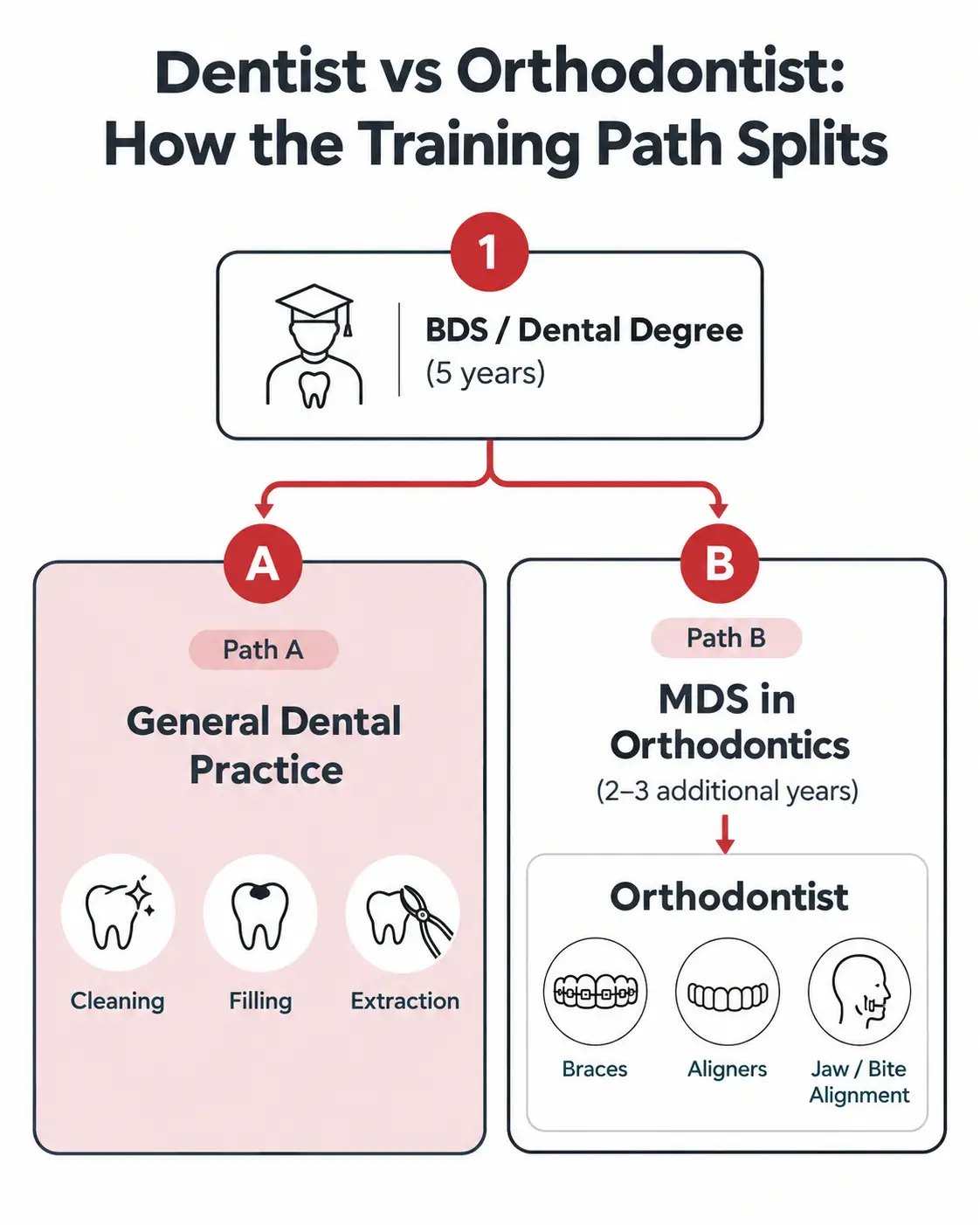
A dentist with a basic degree, a BDS, can legally handle simple orthodontic cases, minor tooth movement or basic aligner therapy, for instance. What a BDS dentist typically isn’t trained for is complex bite correction, jaw growth issues in kids, or cases that need surgical planning. That’s the exact gap an orthodontist’s extra postgraduate training, usually an MDS in Orthodontics, is built to close.
Curious whether your case needs a general dentist or specialist orthodontic care? Explore our orthodontic treatment options at WiseDent.
Who Should You See for Braces, a Dentist or an Orthodontist?
Braces can technically be placed by either. The training behind that placement isn’t quite the same.
Qualification difference: An orthodontist spends extra years in postgraduate study, focused only on tooth movement and bite mechanics, well beyond the standard dental degree.
Scope of treatment: A general dentist covers the day-to-day. An orthodontist zeroes in on alignment and jaw relationships specifically.
Complex case handling: Severe crowding, jaw surgery coordination, or growth-related bite issues, these usually call for an orthodontist’s training.
Simple cases can go either way: For mild spacing or minor shifts, a general dentist with orthodontic training might be enough. Depends on the case, not a fixed rule.
Weighing which dental specialist fits your situation? Compare your tooth replacement options here.
Wondering whether you need a general dentist or an orthodontist? A quick exam settles that.
Why Choose Dr. Vineet Golchha for Orthodontic Treatment in Noida?
Dr. Vineet Golchha holds an MDS in Orthodontics from Rajiv Gandhi University of Health Sciences, plus a fellowship in esthetic dentistry and implants, credentials that go well beyond a standard dental degree. He’s treated over 2,000 orthodontic cases and teaches as a professor of orthodontics at Inderprastha Dental College, which keeps his training tied to current research, not just years of repetition. That specialization’s why patients across Sector 116 come to him specifically for alignment and bite correction, not just general dental care.
Frequently Asked Questions
Is an orthodontist better than a dentist?
Not really.They just treat different types of dental problems.
What can an orthodontist do that a dentist can't?
Handle complex bite correction and jaw alignment cases, mainly.
Can a BDS dentist do orthodontic treatment?
For simple cases, yes. Complex ones need a specialist.
Who typically handles braces, a dentist or an orthodontist?
Either can, but orthodontists are trained for the complex cases.