
Getting dental implants and braces together isn’t quite as straightforward as scheduling both. An implant fuses directly into the jawbone, and that fusion, called osseointegration, takes several months to complete. Once it’s done, the implant sits fixed. It won’t shift the way a natural tooth would under orthodontic pressure. So the real question isn’t whether you can have both. It’s which one needs to happen first.

According to Prof. (Dr.) Vineet Golchha, a leading dentist in Sector 116 Noida, “Patients often assume implants and braces can happen in any order. That’s not quite right. An implant, once fused to the bone, doesn’t budge. So orthodontic movement usually has to happen first, or be planned very carefully around an implant that’s already in place.”

Why Does Treatment Order Matter for Implants and Braces?
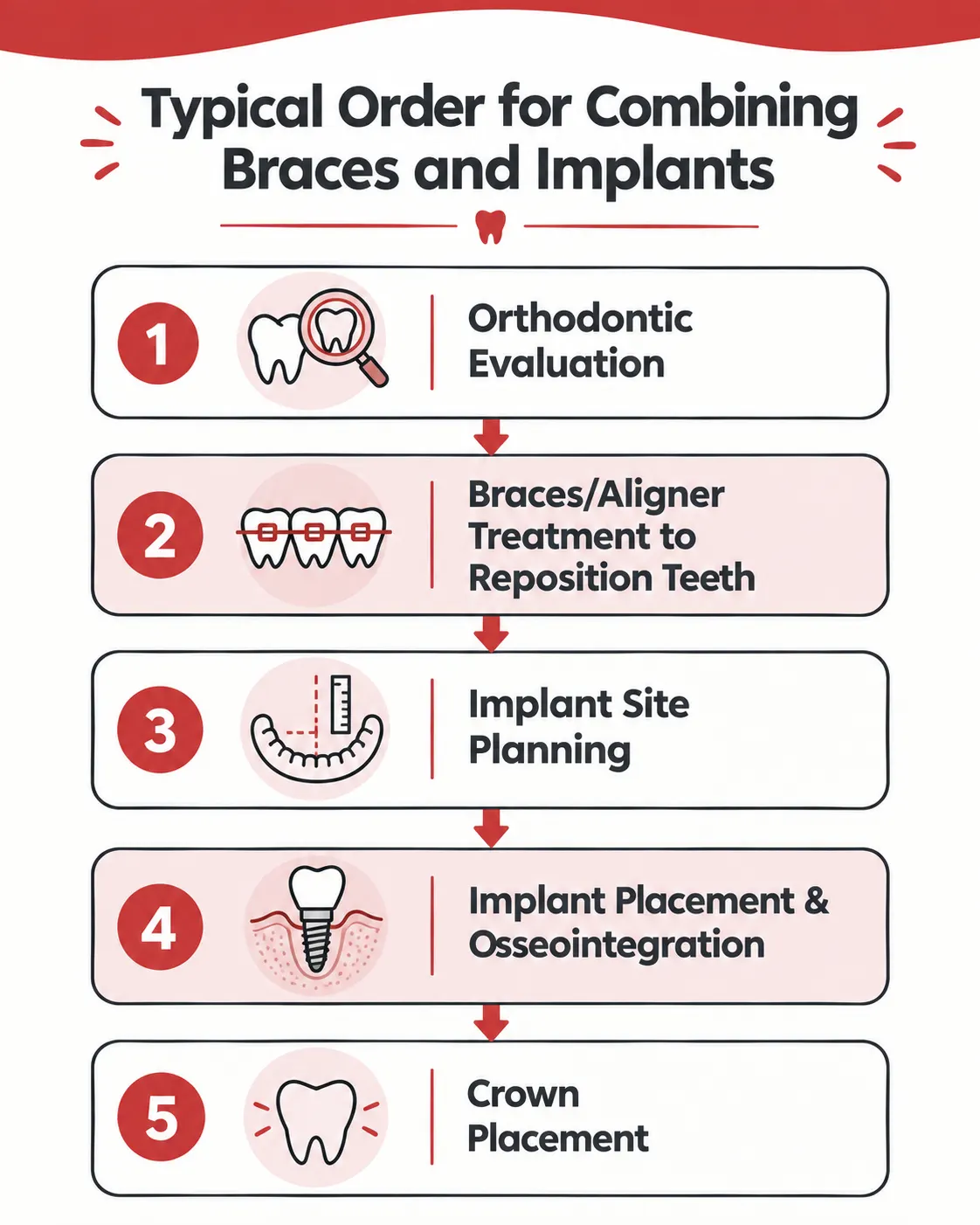
The sequence isn’t arbitrary. It comes down to basic biology.
Step-by-step infographic showing the typical treatment order for combining braces and dental implants: evaluation, orthodontic movement, implant planning, placement and healing, then crown placement.
In some cases, an existing implant actually becomes useful during orthodontic treatment. It can serve as a fixed anchor point since it won’t move, which orthodontists sometimes use to their advantage when shifting other teeth. But if braces are needed for the overall bite and an implant’s already placed in the wrong spot for the final tooth position, that implant may need to be removed and redone later. That’s an expensive problem worth avoiding with the right planning upfront.

Curious where an implant might fit into your orthodontic plan? Explore our dental implants treatment at WiseDent

What's the Right Order for Combining Braces and Implants?

Most cases follow a similar sequence. But it depends on where the missing tooth is.
Scenario Recommended Order Why
Missing tooth plus crowding Braces first, then implant Braces close gaps or create proper spacing before implant placement
Single missing tooth, no crowding Implant first, then minor braces if needed Less orthodontic movement needed around the implant site
Implant placed before braces are needed Orthodontic plan builds around the implant’s fixed spot The implant stays put, so treatment shifts to accommodate it
Braces typically go first: Shifting teeth into their final spot before an implant goes in usually avoids a costly redo down the line.

Implant placement follows a stable plan: Once braces wrap up, scans confirm the exact spot before anything gets placed.

Movement stops at the implant: Nearby teeth can still shift, the implant itself won’t. Planning has to account for that difference.

Sequencing affects total treatment time: Get the order right, and combined treatment can actually finish faster than correcting a poorly sequenced case later.

Considering implants alongside other tooth replacement options? Compare your tooth replacement options here.

u
Wondering whether your case needs braces before implants, or the other way around? A treatment plan will tell you exactly.

Why Choose Dr. Vineet Golchha for Combined Implant and Orthodontic Care in Noida?

Dr. Vineet Golchha‘s fellowship training spans both esthetic dentistry and implants, a combination that lets him sequence implant and orthodontic treatment himself instead of shuttling patients between separate specialists. Every combined case opens with a joint evaluation: bite, missing tooth position, bone density, before deciding what comes first, braces or the implant. That upfront planning heads off the costly scenario of placing an implant that later has to come out to make room for orthodontic movement. 

Frequently Asked Questions

Can I get braces and dental implants at the same time?
Rarely together. Most cases follow a planned sequence instead.
Should braces come before or after a dental implant?
Braces usually come first, especially if teeth need repositioning nearby.
Once placed, can a dental implant still move?
No. Once fused to the bone, it stays exactly where it is.
Will an existing implant affect orthodontic treatment?
Yes, the plan has to work around its fixed position.

References:

Disclaimer: This blog is for general educational purposes only and is not a substitute for professional dental diagnosis; please consult a qualified dentist for personalised advice.
Call Now Button